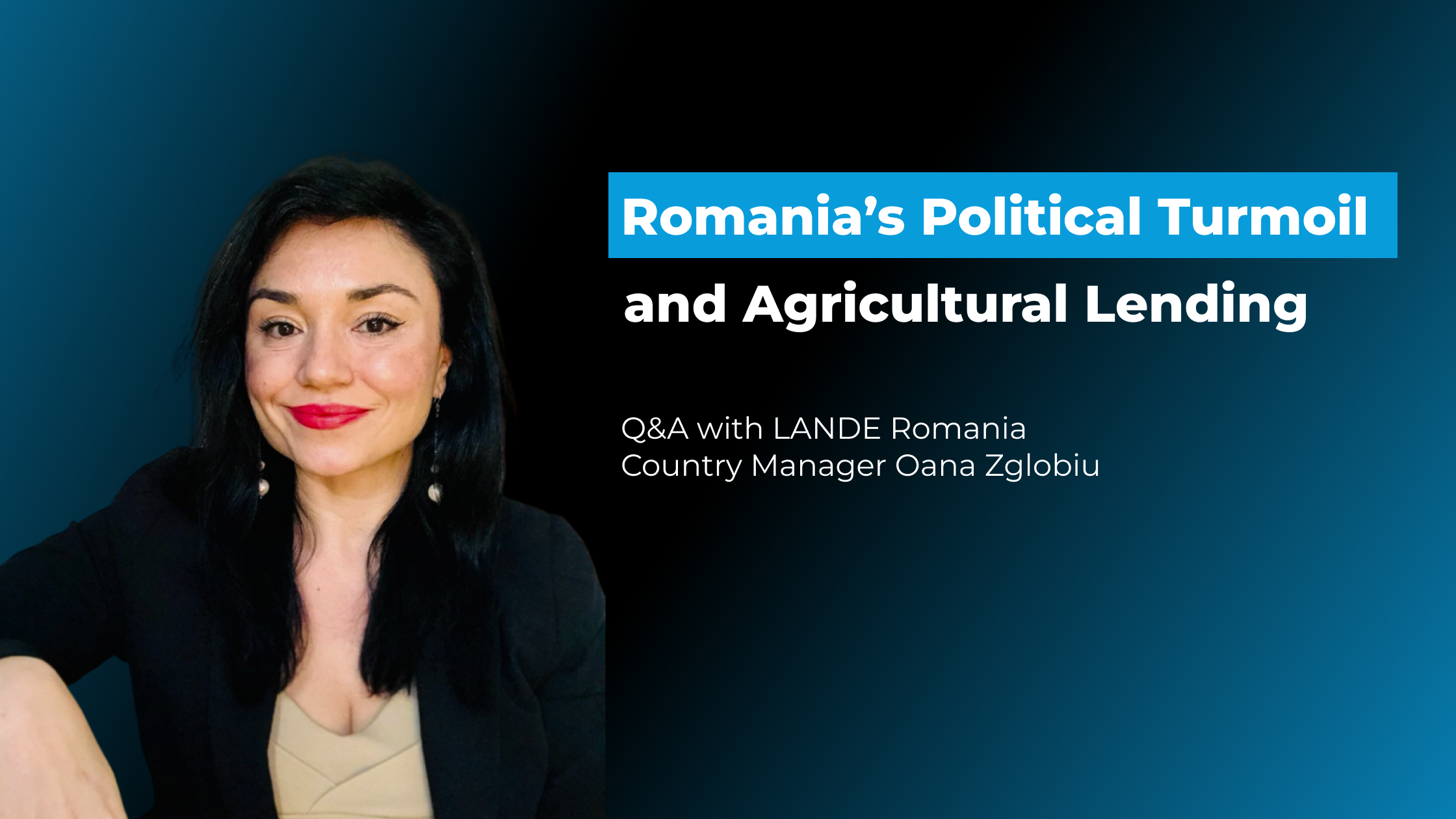
Recent political developments in Romania have raised questions among some investors about the country’s economic stability and the potential impact on agricultural financing. Media headlines discussing government instability, budget deficits, and even speculative scenarios around default risks have naturally created concern.
We spoke with Oana Zglobiu, LANDE Romania Country Manager, who has been working in the Romanian financial market since 2002 and financing farmers specifically since 2012, to get a perspective about the current situation, the resilience of the agricultural sector, and how LANDE evaluates risks in Romania.
Investors are seeing alarming headlines about Romania. How serious is the situation really?
Political instability always creates uncertainty in the short term, especially when media coverage focuses heavily on worst-case scenarios. However, government changes and coalition tensions are also a normal part of democratic political processes across Europe.
From my perspective, it is important to separate political headlines from the underlying fundamentals of the agricultural sector and the broader economy.
Romania remains an EU member state with continued access to European support mechanisms and agricultural funding. The agricultural sector itself has gone through several difficult periods over the past years, including the war in Ukraine, inflation pressures, market volatility, and regulatory changes. Despite this, the sector has continued operating and adapting.
Some media discussions mention large deficits or even country default risks. Could it affect Romanian farmers and LANDE's loans?
Media coverage often amplifies risks because uncertainty attracts attention. That does not mean risks should be ignored, but it is important to keep them in perspective.
Romania’s debt-to-GDP ratio remains below the EU average and significantly below several larger European economies. The country also continues to benefit from EU funding and institutional support frameworks.
For agriculture specifically, there are several structural factors that provide resilience.
Many Romanian farms receive EU agricultural subsidies, which are linked to EUR values while being paid in local currency. If the Romanian leu weakens, the value of these subsidies in local currency can actually increase. Also, the Ministry of Agriculture and Rural Development budget for 2026 is already approved.
In addition, larger farms often combine several stabilizing factors: agricultural land ownership, subsidy income, and export-oriented crop production that can partially benefit from EUR or USD-linked revenues.
You've been in this market since 2002. Have you seen situations like this before?
Many times. The past few years alone have been exceptionally difficult for Romanian agriculture the war in Ukraine disrupted grain markets, inflation peaked sharply in 2023, and farmers went through consecutive debt moratoriums, two dedicated only for farmers. Regulatory uncertainty added to the pressure.
And yet, each time, the sector adjusted rather than collapsed. Over the past five years, the number of farms receiving EU subsidies has remained broadly stable, despite the repeated shocks across the sector. Today, around 700,000 farms consistently qualify for and receive EU subsidies, meaning they've passed verification and due diligence processes. That's a sign of a maturing, structured sector, not a fragile one.
Political crises come and go. Romanian agriculture has shown, repeatedly, that it adjusts.
Are you still comfortable financing Romanian agricultural projects?
Yes. We continue financing Romanian farmers while maintaining our regular risk assessment standards and portfolio monitoring processes.
Agriculture is fundamentally a defensive sector because food production remains essential regardless of political cycles. At LANDE, we also focus strongly on collateral quality and careful project structuring.
Th largest share of Romanian projects on the platform are backed by agricultural land or mix of machinery and agricultural land, which are tangible productive assets. Agricultural land in particular remains one of the most stable long-term agricultural assets.
Any final message to concerned investors?
Political changes do not stop agriculture, but they do require a more careful and rigorous approach to risk assessment. We remain in close dialogue with our farmers, and the reality on the ground is pragmatic: LANDE clients have already signed their contracts, autumn crops are developing well, and agricultural operations are continuing according to plan.
The main concern expressed by farmers is not production‑related, but rather the possibility that access to financing could become more restrictive in a context of heightened political and macroeconomic uncertainty. This is precisely where the role of specialised agricultural financiers becomes critical.
At LANDE, we continue to assess every financing request with speed and discipline, adapting our approach to the current environment. In periods of elevated uncertainty, we remain focused on prudent, cash‑flow‑driven financing structures supported by strong collateral, protecting investor capital while ensuring the continuity of agricultural production.